






Stem Cell Treatment for Knees
What Is Stem Cell Treatment for the Knee — and What Is It Not?
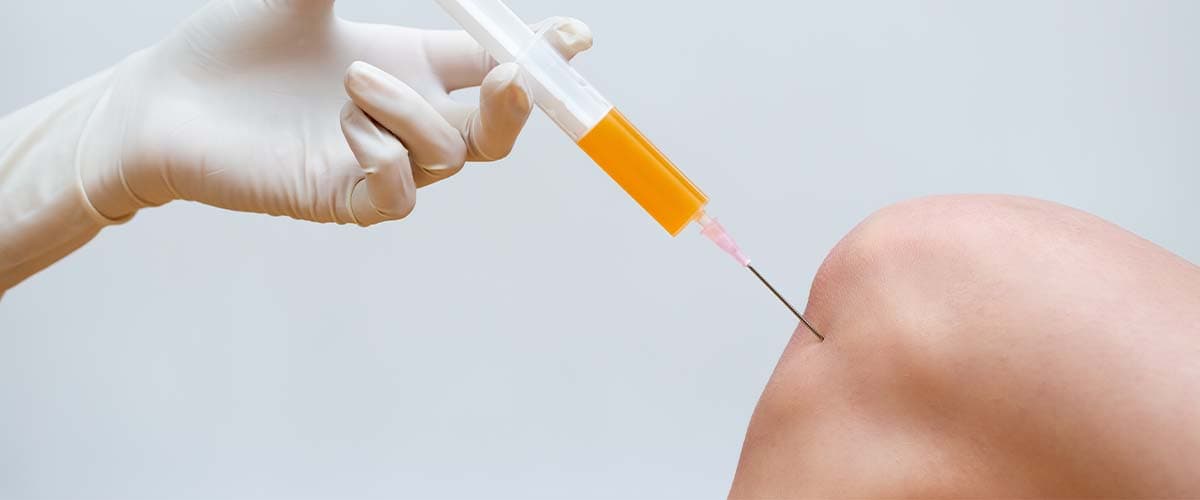
Stem cell treatment for the knee is an umbrella label for injecting a cell-containing preparation into the knee joint. It is not the name of one standardised procedure. The products offered under this heading differ substantially in their source tissue, in how they are processed and in what they actually contain, so the specific preparation being proposed matters far more than the general term. The pages on orthopedic stem cell therapy and biological treatments explain where these injections sit alongside other options.
Whatever it is called, none of these preparations has been shown to build new, normal cartilage inside the knee. Reversing osteoarthritis, restoring worn cartilage or removing the need for a knee replacement cannot be promised on the basis of current evidence. The realistic question is whether a selected patient may gain some improvement in pain and function.
Which Preparations Are Sold Under This Name?
The same wording is applied to products that are not interchangeable. It is reasonable to ask which one is planned and why it was chosen.
- Bone marrow aspirate concentrate (BMAC): marrow drawn from the pelvis, concentrated and injected during the same visit. It is a mixture of many cell types, platelets and plasma rather than a purified stem cell product.
- Adipose-derived preparations: cells obtained from the patient's own fat tissue by mechanical or enzymatic processing. Composition varies widely with the technique used.
- Culture-expanded mesenchymal stromal cells: cells grown in a laboratory before they are used, and regulated differently from same-day autologous preparations in most countries.
- Donor-derived and perinatal products: material from amniotic membrane, umbilical cord or placenta. Claims that these contain living stem cells have frequently not been confirmed by independent testing.
The overview of stem cell joint injections compares these groups in more detail. A result reported for one preparation cannot be assumed to apply to another made from a different source by a different method.
What Does the Treatment Realistically Aim At?
In knee osteoarthritis, the stated purpose of a cellular injection is to influence the joint environment and the pain response in order to reduce symptoms. A change on a scan is not proof of structural repair; the measures that count are the patient's pain, range of motion and everyday function.
Goals should therefore be expressed in measurable terms: less pain on stairs, walking a given distance comfortably, or a quieter night. Phrases such as "regenerating cartilage" or "avoiding surgery altogether" are not measurable goals and are not supported by the current evidence.
What Does the Evidence Show in Knee Osteoarthritis?
The knee is by far the most studied joint for cellular injections, and most of the published work concerns knee osteoarthritis. Even so, the studies differ in the product used, the processing system, the dose, the stage of disease, the comparison group and the outcome measures, and many were carried out in small numbers of patients.
Some studies report short- to medium-term improvement in pain and function in selected patients. Others have shown no clear advantage over placebo, over hyaluronic acid or over PRP injection therapy. Long-term benefit, the optimal preparation and whether repeat injections are needed all remain uncertain.
Professional bodies have not reached the same conclusion. Some guidelines advise against routine use because of the lack of standardisation and of high-quality comparative trials, while more recent expert consensus statements accept that the option may be discussed in selected knee osteoarthritis cases once established treatments have failed to give an adequate result. That is not the same as proven standard care, and it does not make every patient a candidate.
Who May Be Considered, and Who Should Not?
A cellular injection is not first-line treatment and is not part of routine care. It can be discussed through shared decision-making only after the diagnosis is confirmed and established non-surgical treatments have been given a fair trial, with the uncertainty stated openly.
- Assessment weighs the stage of arthritis, loss of joint space, limb alignment, restricted movement, body weight and general health together.
- Mechanical symptoms such as locking, giving way or a significant effusion should be investigated for their cause first.
- The procedure is not appropriate in active joint or skin infection, an untreated bleeding disorder, or an active malignancy under treatment.
- In advanced disease with bone-on-bone contact and marked deformity, expectations are unlikely to be met.
In that last group, a timely joint replacement assessment usually offers more predictable pain relief. Postponing that conversation in the hope that an injection will make it unnecessary can simply prolong a painful and restricted period.
Assessment and Preparation Before the Procedure
The decision rests on history and examination rather than on imaging alone. The consultation covers where the pain is, how long it has been present, whether it wakes the patient at night, which movements aggravate it and what has already been tried. Examination assesses range of motion, swelling, stability, alignment and gait.
Weight-bearing radiographs show joint space, alignment and osteophytes; MRI is added only when meniscal, cartilage or ligament detail would change the plan. The guide to knee osteoarthritis treatment describes how these findings steer the choice between options. Where inflammatory arthritis or infection is possible, blood tests and joint aspiration come before any biological injection.
Blood-thinning medication, supplements, allergies and any treatment affecting the immune system must be declared beforehand, and no medicine should be stopped without medical advice. Recording baseline pain, movement and function makes it far easier to judge genuine change at follow-up.
How the Procedure Is Carried Out
When a bone marrow preparation is chosen, the sequence is usually as follows, with every step performed under sterile conditions.
- The skin over the pelvis is cleaned, local anaesthetic is given and the harvest site is identified.
- Marrow is aspirated through a needle placed into the iliac crest, often from more than one position to improve the cell yield.
- The aspirate is centrifuged in a closed processing system to separate the cellular fraction from red cells and excess plasma.
- The concentrate is injected into the knee joint, often with ultrasound or fluoroscopic guidance to confirm needle position.
The number and type of cells obtained vary between patients and between systems, and no same-day device delivers a defined, guaranteed dose. Patients are entitled to ask what will be collected, how it will be processed and what will be injected.
The Day of the Procedure, Aftercare and Rehabilitation
The procedure is usually a day case performed under local anaesthesia, sometimes with light sedation while marrow is harvested. Harvest, processing and injection together commonly take about one to two hours depending on the system used. Driving on the same day is not advised when sedation has been given or when the leg has been injected.
Soreness at the harvest site and a temporary increase in knee pain or a feeling of fullness are common in the first days and usually settle on their own. Ice, simple analgesia and relative rest are generally enough. Anti-inflammatory medication is restricted for a short period around a biological injection in some centres; because practice varies, the treating surgeon's instruction should be followed rather than a general rule found online.
An injection is not a treatment on its own — the functional result depends on the programme that follows it. Range of motion is protected first, quadriceps and hip muscle strength are then rebuilt, and loading and sport-specific work are reintroduced last. A personalised programme is planned for each patient, and gradual progression matters more than a fixed calendar because response times differ considerably between individuals.
Risks and Possible Complications
The risks are those of a joint injection plus, where marrow is taken, those of the harvest itself. They include pain and bruising, bleeding or haematoma, joint or skin infection, a temporary inflammatory flare and injury to nearby nerves or vessels. Pain at the pelvic harvest site can last for several days.
Using the patient's own tissue does not remove every risk, since preparation, handling and delivery all determine sterility and content. Donor-derived products add concerns about disease transmission and about processing that the patient cannot verify. Autologous and donor-derived preparations should therefore never be presented as equivalent.
Cost, Insurance Cover and Regulatory Reality
Because these treatments are not classified as proven standard care in many countries, they commonly fall outside public and private insurance cover and are paid for by the patient. The regulatory status of the products is not uniform either: same-day autologous preparations, laboratory-expanded cells and donor-derived material are governed by different rules.
That means repeated injections can add up to a substantial expense. Cost, the strength of the evidence and the established options available for the same problem all belong in the same conversation.
Alternatives Worth Comparing
Before agreeing to a cellular injection it is worth reviewing what else exists for the same problem: weight management, activity modification, a supervised strengthening and physiotherapy programme, pain management, bracing or insoles, and corticosteroid or hyaluronic acid injections.
In selected patients whose limb alignment is abnormal and whose wear is confined to one compartment, knee osteotomy can shift load towards the healthier side of the joint. In advanced disease with widespread joint space loss and severe functional limitation, knee replacement may deliver more predictable relief. None of these options automatically substitutes for another; the decision follows symptoms, imaging, general health and personal goals.
When Should You See a Doctor?
Before any planned procedure, a knee that suddenly becomes hot, red and rapidly swollen, fever, severe pain after an injury or an inability to bear weight all require urgent assessment. These findings should not be treated as an ordinary osteoarthritis flare.
After a procedure, report without delay any increasing redness, drainage, worsening swelling or pain, persistent fever, new numbness or weakness, a change in the colour of the leg, breathing difficulty or signs of an allergic reaction.
For general information on established treatments for knee problems you can review the knee section, and to have your own suitability and the alternatives assessed you can request an appointment through the contact page.